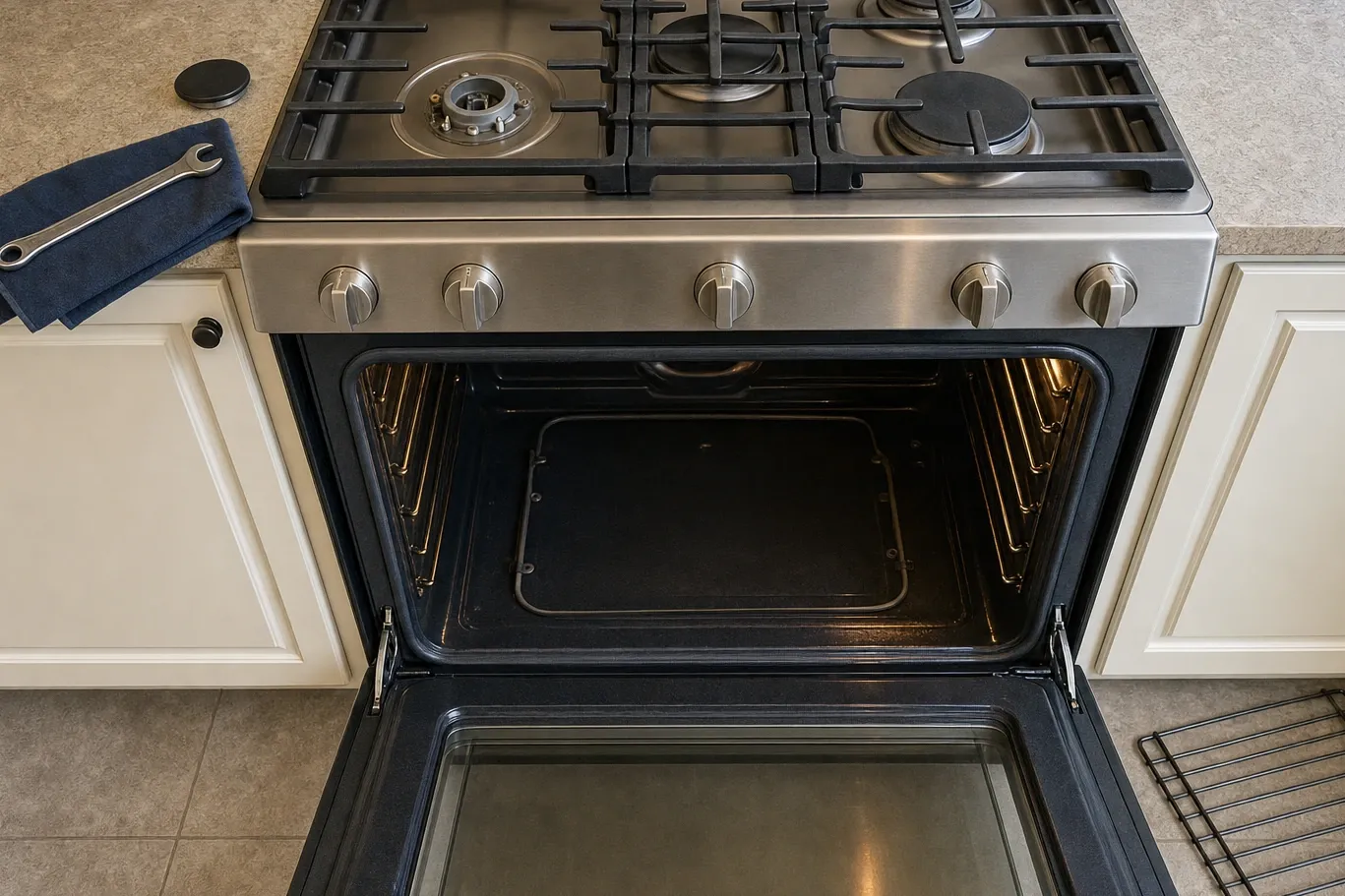
Wolf Oven Bakes Pale and Sunken: Reading the Real Cause
Bread that stays pale and cakes that sink point at a cavity not holding the temperature it claims. What to measure first, what actually drifts, and which of the four usual causes it turns out to be.
Written by Desmond Achebe Cooking-appliance technician — controls and fault codes · 11 years in the trade
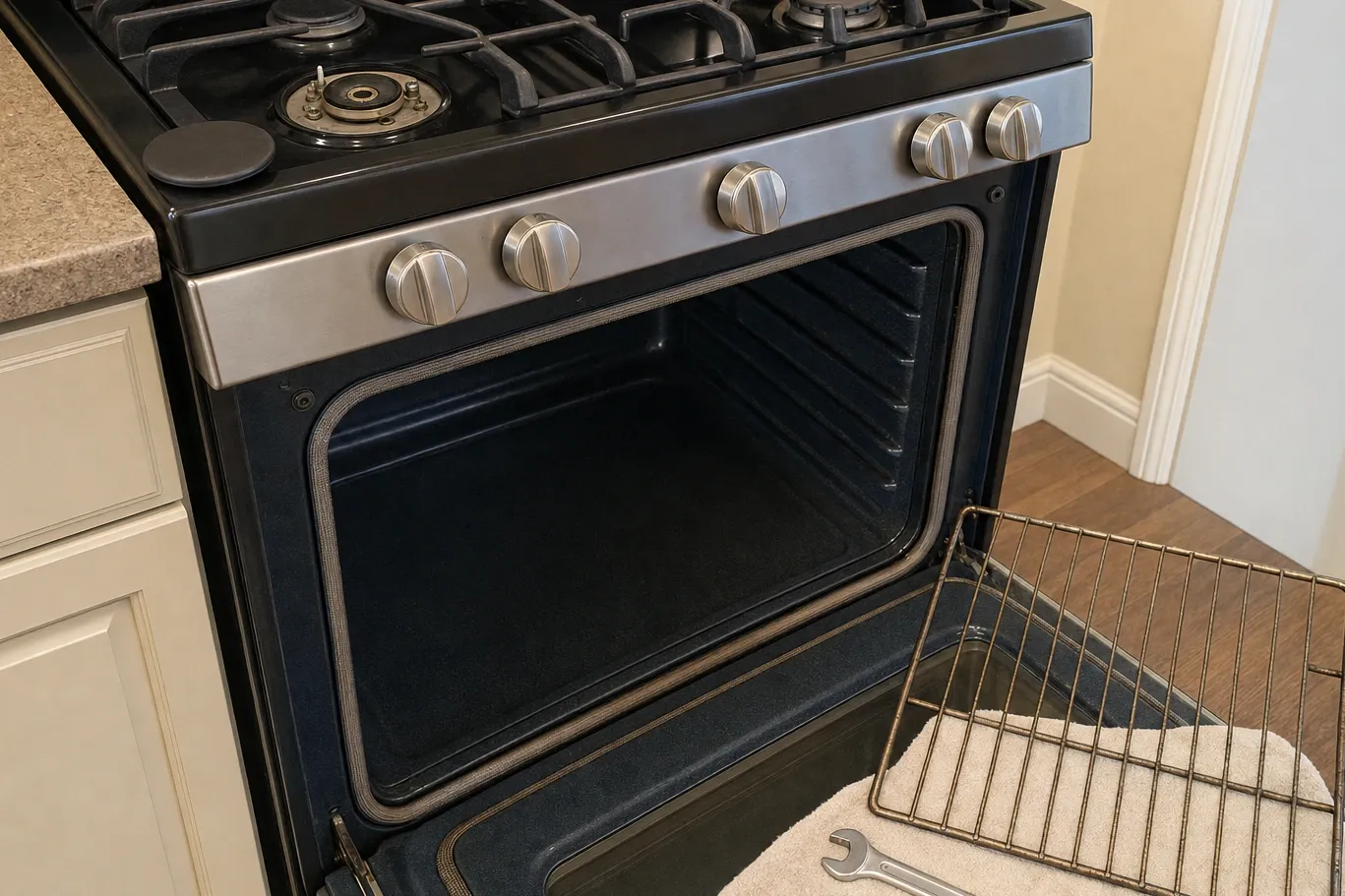
Pale crusts, cakes that rise and then sink in the middle, roast potatoes that soften without ever browning: all of them are the same complaint. The oven is not delivering the temperature it says it is delivering, and the recipe is being asked to do the impossible.
Before anything gets replaced, this is worth diagnosing carefully, because four quite different faults produce nearly the same symptom, and only one of them involves an expensive part.
What a pale bake is telling you
Browning is not a matter of time. It needs a threshold temperature at the surface of the food, and below that threshold you can leave a loaf in for another twenty minutes and get a slightly drier pale loaf rather than a browner one.
A sunken middle says something slightly different. It means the structure set too slowly — the outside never firmed up early enough to hold what the inside was doing. Together, pale and sunken point at a cavity that is running cooler than the dial, or one that is losing heat as fast as it makes it.
That distinction matters. An oven that is uniformly low behaves like a calibration or a sensor problem. An oven that loses what it makes behaves like a seal, a hinge, or a fan problem. You can tell them apart in one afternoon with a thermometer.
Measure it before you trust it
Put a decent oven thermometer on the middle shelf, in the centre. Set the oven to 350°F and leave it alone for at least twenty-five minutes after it says it has reached temperature — the walls and the shelves have to soak, and reading it the moment the tone sounds is how people convince themselves an oven is fine when it is not.
Then read it every five minutes for another twenty. One number on its own proves nothing; the shape those readings make is the diagnosis:
- Steady, and low by a similar margin the whole time. A calibration or sensor issue. This is the cheap end.
- Reaches the set point, then falls away and takes a long time to recover. Something is either leaking heat or not producing it reliably.
- Swings widely — well over, then well under. The control is cycling badly, often a sensor that has become erratic rather than simply inaccurate.
- Different by shelf position, top versus bottom. Air is not circulating, which puts the convection fan or its housing at the front of the queue.
Write the numbers down. On a call, that sheet of paper is worth more than any description of the bread.
The four usual causes, in the order we find them
A drifting temperature sensor. The resistance of the probe changes with age, and the control obediently believes it. Symptom: consistently low or high by a stable margin. It is diagnosed with a meter against the resistance table for the model, and the part itself is one of the smaller ones in the appliance.
A tired door seal. Dry air in this city is hard on gaskets. They shrink, go hard, and stop closing at the top corners first. Symptom: heat escaping over the door, discolouration on the cabinet above it, and a cavity that cannot hold what it reaches. Often accompanied by a door that no longer feels like it pulls itself shut over the last inch.
A weak or failing element, or a lazy igniter on gas. Symptom: takes far too long to preheat, then never quite holds. On a gas cavity, watch the burner light — a slow, thumping ignition means gas is building before the flame takes, and that igniter is on its way out. On electric, an element that glows unevenly along its length is telling you plainly.
A convection fan that has stopped moving air properly. Symptom: the difference between shelves, and browning that happens on one side of the tray. Sometimes the fan is still turning but the housing is packed with baked-on residue, which is a cleaning job rather than a motor.
What the door has to do with baking
Worth its own section, because it is the one people dismiss. Take a strip of paper and close the door on it, then pull. Do that at six or eight positions all the way around, including the top corners. If it slides out easily at any of them, the seal is not sealing there.
Look at the gasket itself in daylight. A healthy one is soft and springs back when you press it. A finished one is stiff, flattened, sometimes cracked at the corner, and has visibly shrunk away from the corner mitre.
Then look at the hinges. A door that has been leaned on, or that has taken the weight of a heavy tray hanging from the handle, sags a fraction of an inch, and a fraction is enough to break the seal at the top while the bottom still looks perfect. Hinge arms and springs are replaceable and are a routine part of this work.
When to stop poking at it
Two situations are worth handing over rather than pursuing.
The first is anything where you have measured a large, steady error and the obvious mechanical causes are ruled out. At that point you are into sensor resistance tables, control board diagnostics and, on gas, manifold pressure — and each of those needs an instrument rather than an opinion.
The second is anything that involves the gas side beyond looking at it. A cavity burner that lights with a thump, a smell of gas, or a flame that lifts away from the burner are not projects. Turn it off at the valve and get someone out.
Everything else — the thermometer test, the paper test, the gasket inspection, the look at how the element glows — is honest homework, and it turns a vague “my oven is not right” into a specific fault that can be quoted properly instead of guessed at.
Follow-ups
- Should I just use the offset calibration in the settings?
- Only after you have measured the cavity. Calibration shifts what the oven aims at, so if the real problem is a lazy element or a leaking door you are teaching the oven to lie in a new direction. Measure, then calibrate if the error is small and even.
- How much drift is normal?
- A few degrees either side of the set point through a cycle is ordinary and no oven holds a flat line. What is not ordinary is a cavity that sits consistently low, or one that swings widely between the top and the bottom of the cycle.
- Can a door seal really change how a cake rises?
- Yes. Heat leaking out over the top of the door pulls the top of the cavity down and lets moisture escape, which is exactly the combination that gives you a pale top and a sunken middle. It is also what marks the cabinetry above the door.